
BGE (BAAI General Embedding)
Open-source embedding and reranker models from BAAI that anchor a huge share of production RAG stacks.
In short
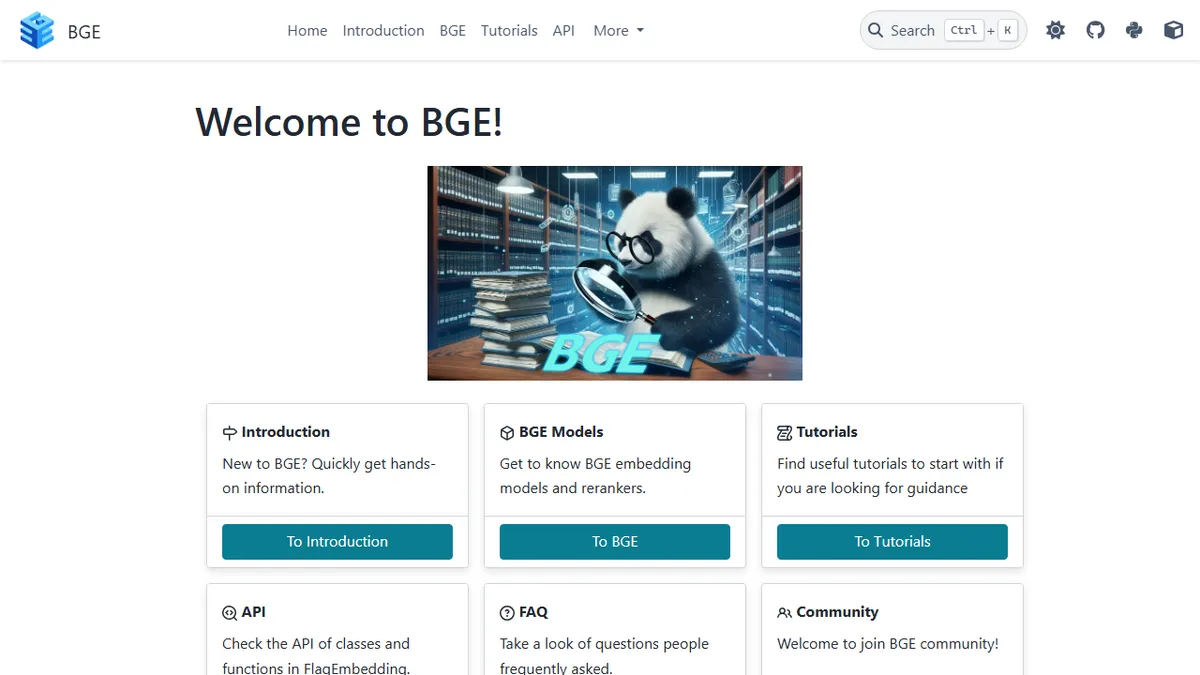
BGE is a family of open-source embedding and reranking models from BAAI designed for engineers building self-hosted RAG pipelines. It offers dense, sparse, and cross-encoder variants with no per-token fees, requiring users to manage their own inference infrastructure.
Pick BGE if you're building a self-hosted RAG stack and want best-in-class open embeddings plus a matching reranker without per-token fees.
Skip it if you want a managed embeddings API with an SLA and a billing dashboard - use Cohere, Voyage, or OpenAI instead.
BGE (BAAI General Embedding) is a family of open-source embedding and reranking models developed by the Beijing Academy of Artificial Intelligence (BAAI), distributed through the FlagEmbedding project. It covers dense retrieval, sparse retrieval, multi-vector (ColBERT-style) retrieval, and cross-encoder rerankers, with multilingual variants (bge-m3) and small/base/large size tiers so you can trade off latency for quality.
It's aimed at engineers building serious RAG pipelines or semantic search who want to self-host rather than pay per-token to OpenAI or Cohere embeddings. Models are free on Hugging Face under permissive licenses, run locally via the FlagEmbedding Python package or any standard inference server (TEI, vLLM, sentence-transformers), and have consistently sat near the top of the MTEB leaderboard. The site itself is a documentation hub - tutorials, API reference, and research notes - not a hosted SaaS.
Integrations are everywhere: LangChain, LlamaIndex, Haystack, Milvus, Qdrant, Weaviate, and Elasticsearch all ship first-class BGE adapters. The catch is that you operate the inference yourself; there is no managed endpoint, no dashboard, no SLA. For teams that already run GPUs or care about data residency, that's the point.
BGE is the default open-source embedding family for a reason: BAAI ships fast, the MTEB numbers hold up in real workloads, and bge-m3 plus bge-reranker-v2 is a genuinely strong two-stage retrieval combo. Just remember you're buying a model, not a service - budget for the GPU.
— The AI Tool Bible editorial team
Pros
- ✅ Top-tier MTEB benchmark performance across English, Chinese, and multilingual tasks
- ✅ Full family: dense, sparse, multi-vector, and cross-encoder rerankers
- ✅ Fully open-source weights, free for commercial use
- ✅ First-class support in LangChain, LlamaIndex, and major vector DBs
- ✅ bge-m3 handles 100+ languages and 8K-token inputs in a single model
Cons
- ⚠️ No hosted API or managed endpoint - you run the GPUs
- ⚠️ Documentation skews academic; less hand-holding than Cohere or Voyage
- ⚠️ Smaller models lag frontier proprietary embeddings on niche domains
Use cases
Frequently asked
- Is BGE a managed API service?
- No, BGE is an open-source model family distributed under the FlagEmbedding project. Users must self-host the inference using tools like TEI, vLLM, or sentence-transformers rather than using a hosted SaaS endpoint.
- What types of retrieval does BGE support?
- BGE covers dense retrieval, sparse retrieval, multi-vector (ColBERT-style) retrieval, and cross-encoder rerankers. The bge-m3 variant specifically handles 100+ languages and supports inputs up to 8K tokens.
- Which frameworks and vector databases support BGE?
- BGE has first-class adapters for LangChain, LlamaIndex, Haystack, Milvus, Qdrant, Weaviate, and Elasticsearch. It is available on Hugging Face under permissive licenses.
- Who is the best fit for using BGE?
- BGE is best for teams building self-hosted RAG stacks who want to avoid per-token fees and have access to GPUs. It is not suitable for those requiring a managed API with an SLA or billing dashboard.
Explore related
Compare with similar tools
All in RAG →Pinecone
FeaturedManaged vector database for production-scale similarity search.
LlamaIndex
FeaturedData framework for connecting LLMs to your data.
Elasticsearch Vector Search
Hybrid vector + keyword search in the enterprise-grade Elasticsearch engine
Snowflake Cortex
Generative AI and RAG built into the Snowflake data cloud
DataStax Astra DB
Serverless vector and document database for production RAG and AI agents
MongoDB Atlas Vector Search
Vector search built into the operational database you're already using.