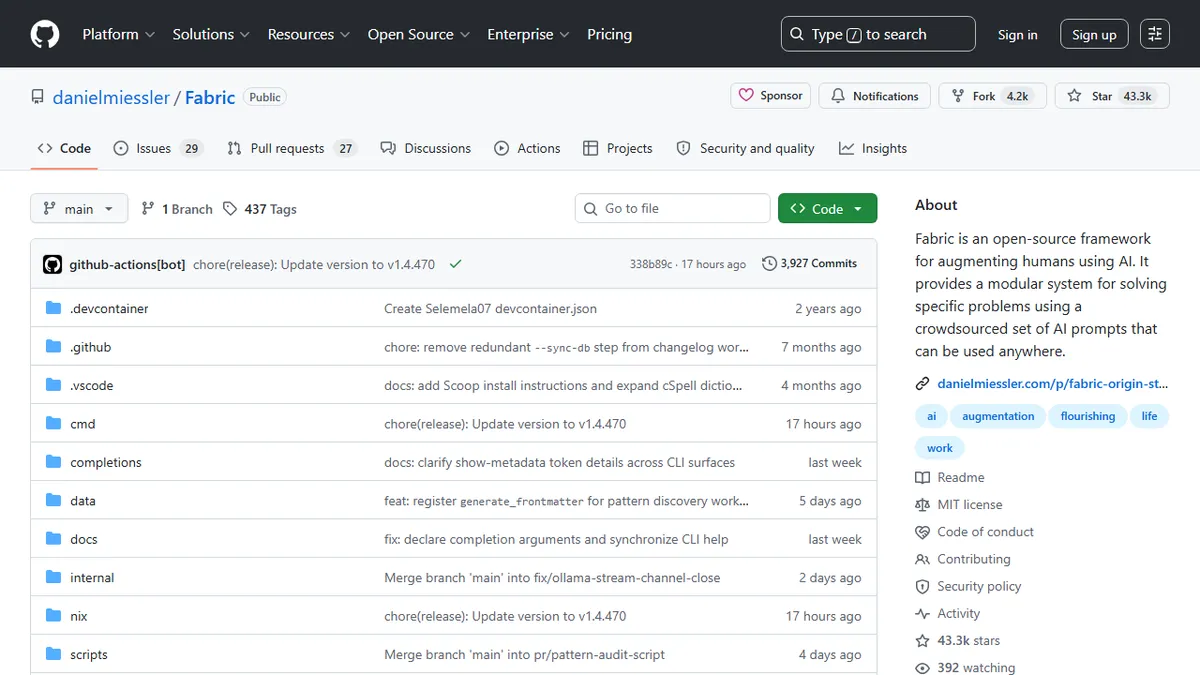
Fabric
An open-source framework for augmenting humans with AI, one composable prompt at a time.
In short
Fabric is a command-line tool that turns AI models into a library of composable, chainable prompts for terminal-native workflows. It is best for developers and security analysts who want to script AI tasks using Unix pipes with provider-agnostic support.
Developers, security analysts and terminal-native power users who want a scriptable, provider-agnostic way to apply reusable AI prompts to files, pipelines and personal knowledge work.
Non-technical users who want a chat UI, teams needing hosted infrastructure with billing and SSO, or anyone who needs managed guardrails, evals and audit logging out of the box.
Fabric is an open-source, command-line-first framework for turning AI models into a library of reusable, chainable prompts. Created by security researcher Daniel Miessler, it addresses what he calls AI's real bottleneck: not model capability, but integration into everyday workflows. Instead of pasting prompts into a chat window, you install a Go binary, pick a 'Pattern' (a curated Markdown prompt such as extract_wisdom, summarize, analyze_claim, create_summary, or write_essay), pipe text into it, and get a structured result on stdout. Patterns can be chained through Unix pipes so a YouTube transcript can flow into extract_wisdom, then into create_summary, then into a social-post generator in a single one-liner. Fabric natively integrates with OpenAI, Anthropic Claude, Google Gemini, Azure OpenAI, Amazon Bedrock, Vertex AI, Ollama, LM Studio and Perplexity, plus many OpenAI-compatible endpoints (Groq, DeepSeek, OpenRouter, Together, Mistral, Cerebras, GitHub Models and others). A --serve mode exposes a REST API with chat-completion, pattern-management, context and session endpoints, and includes Ollama-compatible routes so existing tooling can point at Fabric as a drop-in backend. The audience is developers, sysadmins, security analysts, researchers and power users who already live in the terminal and want AI to behave like just another Unix tool: composable, scriptable, and versioned in Git alongside their own custom patterns.
Fabric is the closest thing the LLM world has to a Unix philosophy: small, composable prompt tools you can pipe together. For anyone comfortable at a shell, it turns 'go paste this into ChatGPT' into a reproducible one-liner, and the ability to swap between Claude, GPT and a local Ollama model with a single flag is genuinely liberating. It is not a product so much as a toolkit, and that is exactly its charm.
— The AI Tool Bible editorial team
Pros
- ✅ Fully open source (MIT) with a large, actively curated pattern library covering summarisation, analysis, extraction and writing tasks.
- ✅ Provider-agnostic: works with commercial APIs (OpenAI, Anthropic, Gemini, Bedrock, Vertex) and local models (Ollama, LM Studio) from one CLI.
- ✅ Composable through Unix pipes, making it trivial to chain patterns and integrate with existing shell scripts and cron jobs.
- ✅ Built-in helpers like YouTube transcript extraction, streaming output, dry-run cost preview and multi-language support.
- ✅ REST API server mode with Ollama-compatible endpoints, so it can act as a backend for other apps.
- ✅ Custom patterns are just Markdown files you can version, share and fork, making prompt engineering reviewable in Git.
Cons
- ⚠️ CLI-first design has a steep learning curve for non-technical users; there is no polished consumer GUI.
- ⚠️ You must bring and manage your own LLM API keys and pay provider costs; Fabric itself is unhosted.
- ⚠️ Pattern quality varies and community contributions are not always benchmarked, so output consistency depends on which pattern you pick.
- ⚠️ Windows support exists but the ergonomics still favour macOS and Linux terminal workflows.
- ⚠️ No built-in evaluation, guardrails or observability layer, so production use requires bolting on your own logging and safety tooling.
Use cases
Frequently asked
- What AI providers does Fabric support?
- Fabric natively integrates with OpenAI, Anthropic Claude, Google Gemini, Azure OpenAI, Amazon Bedrock, Vertex AI, Ollama, LM Studio, and Perplexity. It also supports many OpenAI-compatible endpoints such as Groq, DeepSeek, and Mistral.
- Is Fabric free to use?
- Yes, Fabric is free and open-source under the MIT license. Users bring their own API keys and pay LLM providers directly, while local models via Ollama or LM Studio incur no per-token cost.
- Can Fabric be used as an API backend for other applications?
- Yes, a --serve mode exposes a REST API with chat-completion and pattern-management endpoints. It includes Ollama-compatible routes so existing tooling can point at Fabric as a drop-in backend.
- Who is the target audience for Fabric?
- The audience is developers, sysadmins, security analysts, researchers, and power users who live in the terminal. It is not designed for non-technical users needing a chat UI or teams requiring hosted infrastructure with billing.
Explore related
Compare with similar tools
All in Agents →LangGraph
FeaturedStateful, graph-based agent orchestration from LangChain.
CrewAI
FeaturedPython framework for multi-agent orchestration.
Ernie Bot
Baidu's Mandarin-first ChatGPT rival, powered by the ERNIE model family
Moveworks
The enterprise AI assistant that searches, answers, and takes action across your business systems
AWS Bedrock
Build and scale generative AI applications with foundation models
Claude Agent SDK
Anthropic's official SDK for building autonomous Claude agents.