
Firecrawl
✓ Editorially verifiedWeb scraping and crawling API that returns LLM-ready markdown, JSON, or structured data from any URL.
Pick Firecrawl if you are building a RAG pipeline or AI agent and want one API call to turn any URL into clean, token-efficient markdown.
Skip it if you only need to scrape a handful of static pages and a quick fetch+cheerio script would do, or if you have hard data-egress constraints.
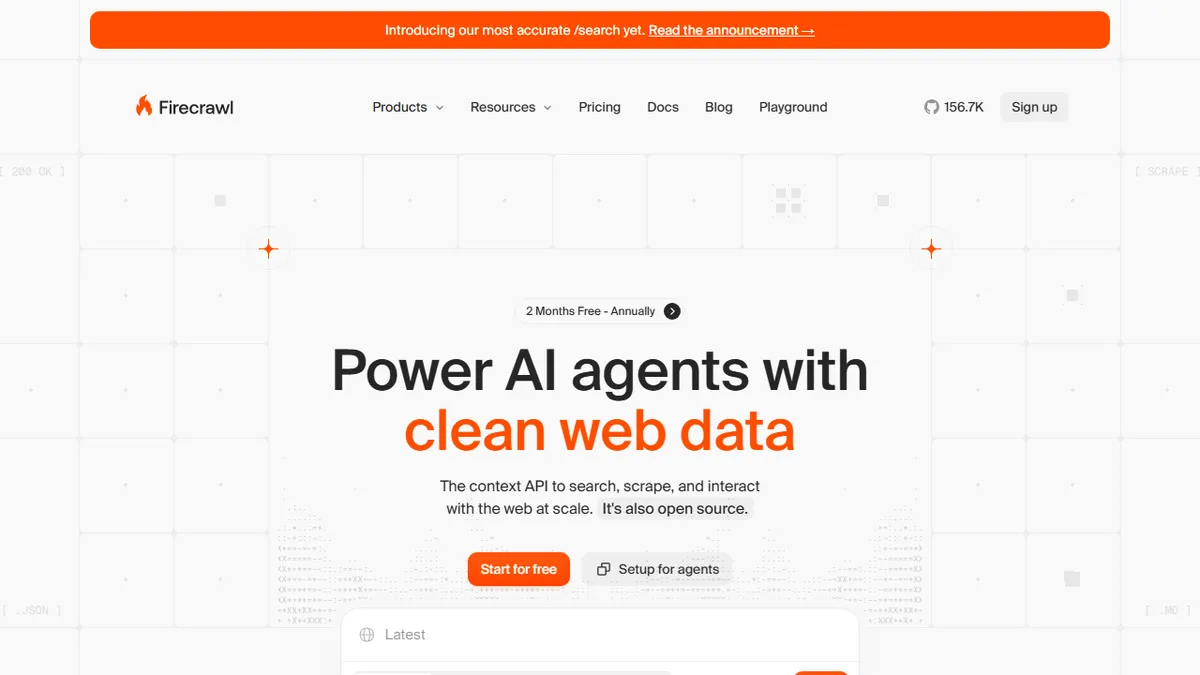
Firecrawl is a web data infrastructure platform built specifically for AI workloads. Give it a URL and it returns clean markdown, structured JSON, HTML, or screenshots; give it a domain and it crawls the whole site, respecting robots.txt and handling JavaScript rendering on the way. It also exposes search, browser actions (clicks, scrolls, form-fills), and media parsing for PDFs and DOCX, with output the company claims is 93% smaller than raw HTML.
The target user is anyone building a RAG pipeline, AI agent, or scraper that needs to feed live web content into an LLM without writing custom Playwright glue for every site. Pricing is credit-based: a free tier of 1,000 credits per month, then Hobby/Standard/Growth monthly plans, with Scale and Enterprise on annual contracts. One scrape or crawled page equals one credit; search costs 2 credits per 10 results, and the interactive browser costs 2 credits per minute.
Firecrawl is open source (the GitHub repo is one of the most-starred in the scraping space) and ships official SDKs for Python, Node.js, Go, Rust, Java, and Elixir, plus a REST API, CLI, and an MCP server that plugs directly into Claude, Cursor, and Windsurf. The hosted service handles proxies, anti-bot, and JS rendering for you; the self-host route exists but is meaningfully more work to operate at scale.
Firecrawl has quietly become the default web-to-LLM layer for serious agent builds, and the MCP server makes it a one-line drop-in for Claude and Cursor. The free tier is enough to prototype, and the open-source repo is a real fallback if pricing stops working at scale. The main tradeoff is credit burn on heavy crawls.
— The AI Tool Bible editorial team
Pros
- ✅ Returns clean LLM-ready markdown/JSON without custom scraper code
- ✅ Handles JS rendering, anti-bot, and PDFs out of the box
- ✅ Open source with SDKs in six languages plus an MCP server
- ✅ Generous 1,000-credit free tier and predictable per-page pricing
Cons
- ⚠️ Credit model gets expensive on million-URL crawls vs DIY scrapers
- ⚠️ Self-hosting is non-trivial compared with the managed API
- ⚠️ Browser interact actions burn credits quickly on long sessions
Use cases
Explore related
Compare with similar tools
All in RAG →Pinecone
FeaturedManaged vector database for production-scale similarity search.
LlamaIndex
FeaturedData framework for connecting LLMs to your data.
Elasticsearch Vector Search
Hybrid vector + keyword search in the enterprise-grade Elasticsearch engine
Snowflake Cortex
Generative AI and RAG built into the Snowflake data cloud
DataStax Astra DB
Serverless vector and document database for production RAG and AI agents
MongoDB Atlas Vector Search
Vector search built into the operational database you're already using.