Foomchat
A chat app that generates its own features on demand
In short
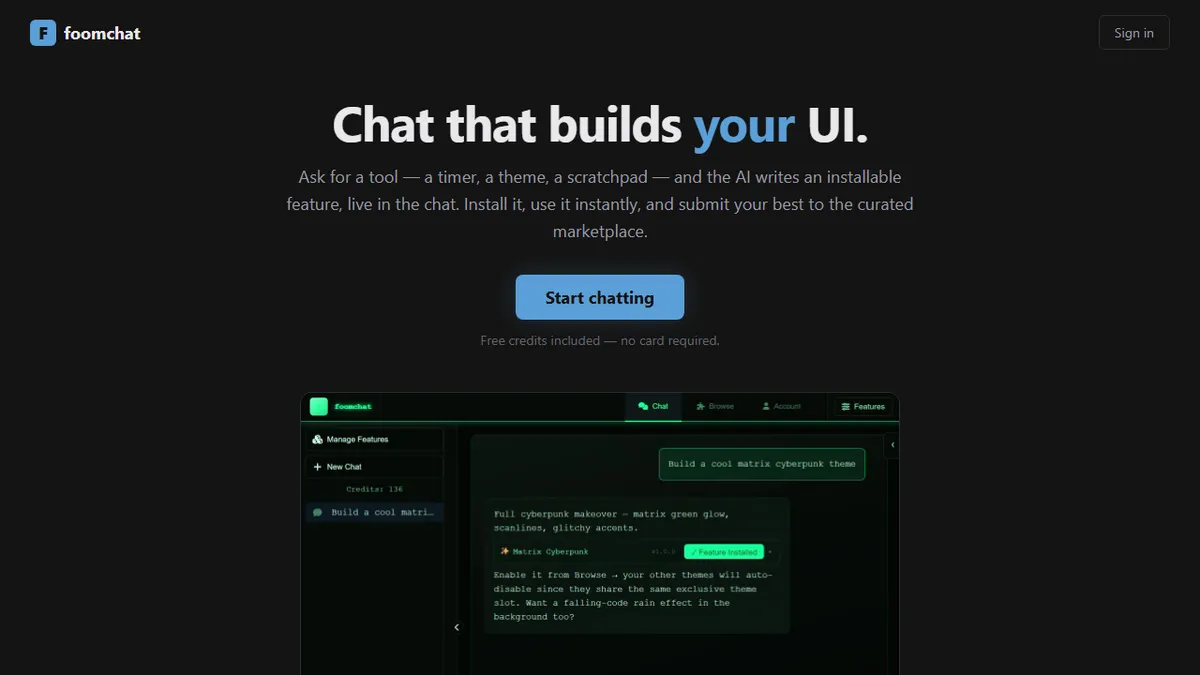
Foomchat is a conversational AI app that turns user requests into live, installable features within the chat interface. It is best for developers and tinkerers who want to prototype small utilities or themes through conversation rather than writing code.
Developers and power users who want a chat client that can extend itself on demand, and hobbyists who enjoy prototyping small widgets or themes through conversation.
Teams that need transparent model choice, a documented API, predictable enterprise pricing, or generated code that runs outside the vendor's chat runtime.
Foomchat is a conversational AI application that turns natural-language requests into installable, live-generated features inside the chat surface itself. Instead of the model producing only text or file output, users describe a tool they want — a pomodoro timer, a theme, a custom widget, a layout tweak, a small utility — and an agent writes the code, spins the feature up in place, and offers to install it into the workspace. Once installed, features can be edited, kept, rolled back, or shared to a curated community marketplace where other users can browse and one-click install submissions that have been approved. In effect the chat window becomes the runtime for an ever-growing catalogue of small apps that the user (or the community) generated on demand. The intended audience is developers and tinkerers who want a self-modifying chat client, plus non-developers who like the idea of asking for a UI element and getting it without touching code. Common workflows include prototyping a small productivity widget in a single conversation, forking or restyling a community-submitted theme, iterating on a personal dashboard component through repeated turns with the agent, and publishing polished features to the marketplace for others to install. The version-control layer around each generated feature is what pulls the experience closer to an agent framework than a chatbot: the user is directing a loop that produces persistent artifacts, not just messages. Foomchat is early-stage: the site does not disclose which underlying model powers generation, whether an API exists, or the shape of paid tiers beyond the free-credit onboarding.
The pitch — a chat app that grows new features by asking for them, with version control and a marketplace — is a genuinely interesting spin on agentic UX. But with no disclosed model, no API, and no visible pricing beyond free credits, this is a curiosity to try, not a tool to standardise on. Worth ten minutes if the concept intrigues you.
— The AI Tool Bible editorial team
Pros
- ✅ Generates installable in-app features from chat rather than dumping code for the user to wire up themselves
- ✅ Version control on every generated feature — edit, keep, or roll back without leaving the conversation
- ✅ Community marketplace lets users browse and install features other people have built and submitted
- ✅ One-click install for themes, widgets, and layouts lowers the barrier for non-developers
- ✅ Free credits with no card required makes it painless to evaluate
- ✅ Positions the chat window itself as the runtime, which is a genuinely different take on agent UX
Cons
- ⚠️ The underlying model family is not disclosed, so buyers cannot assess capability or data-handling implications
- ⚠️ No public pricing beyond free credits — hard to plan around long-term cost
- ⚠️ No documented API, so features live inside Foomchat's own client rather than composing with other tools
- ⚠️ Marketplace quality depends on curation velocity; early catalogues are often thin
- ⚠️ Generated features are scoped to the chat surface, not standalone apps you can host elsewhere
- ⚠️ Very new product with limited third-party reviews or track record to reference
Use cases
Frequently asked
- What kind of features can Foomchat generate?
- Users can request installable tools such as pomodoro timers, custom themes, widgets, layout tweaks, and small utilities. The app writes the code and spins up the feature directly in the chat surface.
- Is there a public API for Foomchat?
- No, the entry states that no API exists. Generated features are scoped to the chat surface and do not compose with other tools or run outside the vendor's client.
- How does version control work in Foomchat?
- Each generated feature has a version-control layer that allows users to edit, keep, or roll back changes without leaving the conversation. This persists artifacts rather than just generating messages.
- Can I share or install features from other users?
- Yes, users can publish polished features to a curated community marketplace. Other users can browse these submissions and one-click install approved themes, widgets, and layouts.
Explore related
Compare with similar tools
All in Agents →LangGraph
FeaturedStateful, graph-based agent orchestration from LangChain.
CrewAI
FeaturedPython framework for multi-agent orchestration.
Ernie Bot
Baidu's Mandarin-first ChatGPT rival, powered by the ERNIE model family
Moveworks
The enterprise AI assistant that searches, answers, and takes action across your business systems
AWS Bedrock
Build and scale generative AI applications with foundation models
Claude Agent SDK
Anthropic's official SDK for building autonomous Claude agents.