LangWatch
Simulation-based testing, evaluation, and observability for LLM agents
In short
LangWatch combines end-to-end tracing, simulation, and LLM-as-a-judge evaluation for production LLM agents. It is best for engineering teams needing to catch regressions and monitor cost in CI using an open-source, self-hostable tool.
Engineering teams building multi-step LLM agents in production who need tracing, scenario-based simulation, and CI-gated evals in one open-source-friendly platform they can self-host if compliance requires it.
Solo builders shipping a single-prompt wrapper or teams that only need lightweight trace logging; the simulation and prompt-management surface will be overkill and the seat pricing hard to justify.
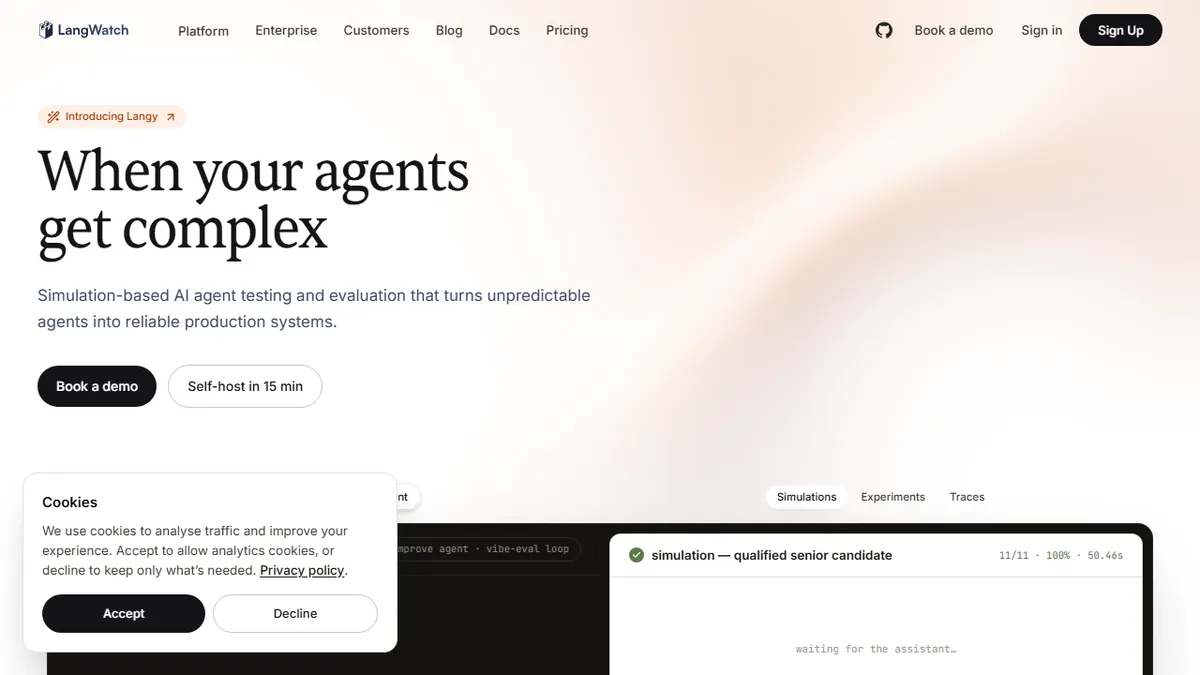
LangWatch is an open-source (Apache 2) observability and evaluation platform aimed at teams shipping production LLM agents. It combines three things that usually live in separate tools: end-to-end tracing of every agent step, token and cost via OpenTelemetry; a simulation harness that runs multi-turn text or voice scenarios against your agent so regressions are caught before deploy; and an LLM-as-a-judge evaluation layer that scores outputs against custom rubrics, safety checks, and factuality tests. The platform also ships a prompt registry with versioning and A/B testing, red-teaming for jailbreak and prompt-injection probes, and 'Langy', an AI-engineer assistant that turns plain-English requirements into tests and opens PRs against your repo. Instrumentation is framework-agnostic: Python, TypeScript and Go SDKs plus native hooks for LangGraph, CrewAI, Vercel AI SDK, LlamaIndex, DSPy, Claude Code, Codex, OpenAI, Anthropic, AWS Bedrock, Azure OpenAI, and Vertex AI. Typical workflows are: instrument an agent, replay production traces as datasets, define scenarios with expected outcomes, run judges on every PR in CI, and watch cost, latency and quality drift on dashboards. The tool is used by Backbase, Deloitte, PagBank, and Visma for mission-critical agent rollouts, and offers cloud, hybrid, and self-hosted deployment for teams with data-residency requirements.
LangWatch is one of the few eval platforms that treats simulation as a first-class citizen instead of a bolt-on, and the OpenTelemetry-native tracing plus Apache 2 license make it a rare buy-vs-build tie-breaker. If you already run agents in production and are chasing regressions with print statements, this is the shortest path to a real evaluation loop.
— The AI Tool Bible editorial team
Pros
- ✅ Apache 2 open source with self-hosted and on-prem deployment options for regulated teams
- ✅ OpenTelemetry-native tracing works with virtually any framework or custom stack
- ✅ Combines observability, evaluation, simulation, and prompt management in one product instead of stitching four tools
- ✅ First-class multi-turn conversation simulation (text and voice), not just single-shot eval
- ✅ LLM-as-a-judge scoring can run on single outputs or entire conversations, including multimodal inputs
- ✅ SDKs in Python, TypeScript, and Go plus deep integrations with LangGraph, CrewAI, DSPy, Bedrock, Vertex, and Azure
- ✅ Generous free tier (50k events/mo) with no credit card, so teams can prove value before buying
Cons
- ⚠️ Feature surface is broad; smaller teams may find the UI heavier than a focused tracer like Langfuse or Phoenix
- ⚠️ LLM-judge evaluations add their own token cost that stacks on top of your agent's inference bill
- ⚠️ Growth plan bills per core-seat and per 100k events, which can escalate quickly on chatty production agents
- ⚠️ Self-hosting the full stack (Postgres, ClickHouse, workers) is non-trivial versus SaaS-only competitors
- ⚠️ Simulation quality depends heavily on how well you author scenarios; poorly written cases give false confidence
Use cases
Frequently asked
- What are the main features of LangWatch?
- It provides end-to-end tracing via OpenTelemetry, a simulation harness for multi-turn scenarios, and an LLM-as-a-judge evaluation layer. It also includes a prompt registry, red-teaming tools, and an AI assistant for test generation.
- Which frameworks and languages does LangWatch support?
- LangWatch offers SDKs for Python, TypeScript, and Go. It has native hooks for LangGraph, CrewAI, Vercel AI SDK, LlamaIndex, DSPy, and major providers like OpenAI, Anthropic, and AWS Bedrock.
- Is LangWatch open source and can it be self-hosted?
- Yes, LangWatch is open source under the Apache 2 license. It supports cloud, hybrid, and self-hosted deployment options for teams with data-residency requirements.
- How is LangWatch priced?
- It uses a freemium model with a free Developer tier. The Growth plan costs €29 per core-seat per month, while Enterprise pricing is custom.
- Who is LangWatch designed for?
- It is best for engineering teams building multi-step LLM agents in production who need tracing, scenario-based simulation, and CI-gated evaluations in a single platform.
Explore related
Compare with similar tools
All in Evaluation →Braintrust
FeaturedEval, monitor, and improve AI products end-to-end.
LangSmith
LangChain's eval + observability platform.
Weights & Biases
The ML experiment tracker, now with LLM eval features.
Helicone
Open-source LLM observability — one-line proxy install.
Arize AI
Enterprise observability and evaluation platform for LLM agents and generative AI applications.
Giskard
Continuous AI red teaming platform that stress-tests LLM agents for vulnerabilities before they hit production.