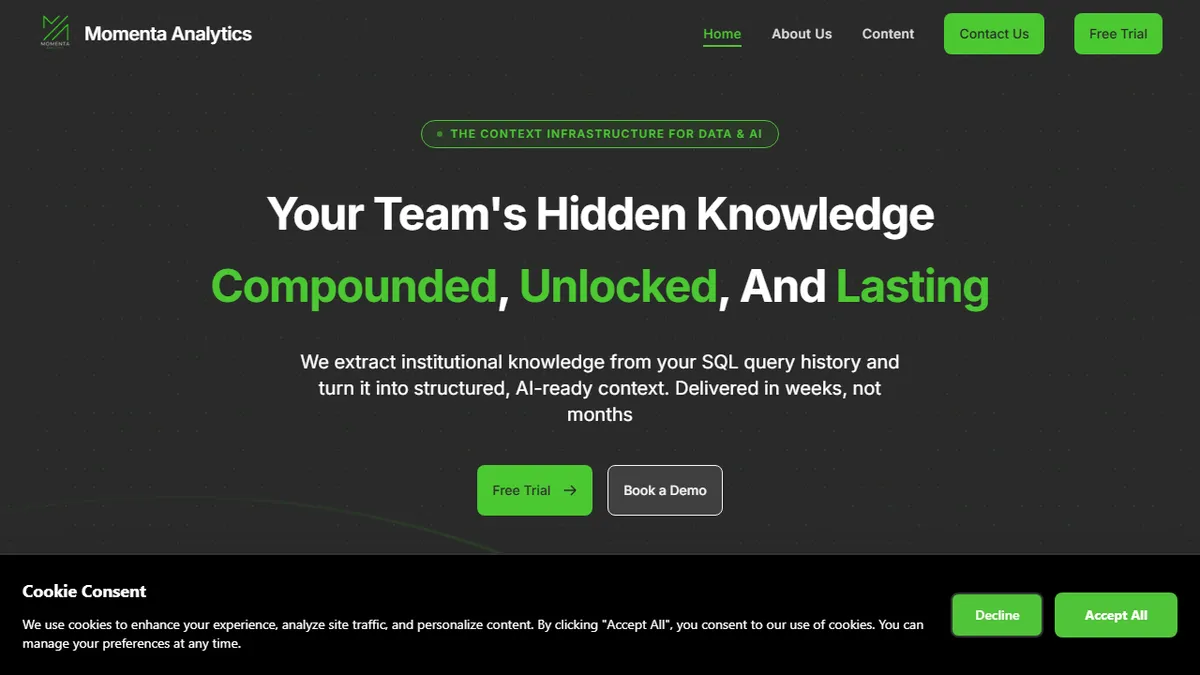
Neuron by Momenta Analytics
Turns SQL query history into an AI-ready semantic layer
In short
Neuron mines SQL query logs to create a machine-readable semantic layer containing KPIs, business rules, and lineage. It is best for analytics teams needing to ground LLM copilots and RAG pipelines in validated metric definitions rather than hand-curated documentation.
Data platform and analytics-engineering teams on Snowflake, Databricks or dbt who want to ground an internal LLM analyst or RAG chatbot in real, validated metric definitions instead of hand-curated docs.
Solo developers, greenfield startups without query history, or teams that need a self-serve SaaS product with transparent pricing and instant sign-up.
Neuron by Momenta Analytics is a semantic-layer builder that mines an organisation's SQL query history to recover the institutional knowledge that lives inside SELECT statements, then packages it into a machine-readable model that AI copilots, RAG pipelines and BI tools can rely on. Instead of asking analysts to hand-author a metrics catalog or waiting for a warehouse team to backfill dbt definitions, Neuron runs a five-stage pipeline (Processing, Lineage mapping, Catalog building, KPI analysis, OSI export) across the query logs from Snowflake, Databricks, BigQuery or a Postgres warehouse and produces a documented library of KPIs, business rules, JOIN patterns and cross-schema dependencies with confidence scores attached. Typical outputs include a metrics library where each KPI ships with its inferred SQL formula, a WHERE-clause pattern library grouped into roughly fourteen business domains, and a lineage graph that shows how tables actually get combined in production versus what the ERD says. The exported semantic package plugs into dbt, into RAG chatbots that need reliable table-and-column grounding, and into text-to-SQL agents that would otherwise hallucinate metric definitions. Common workflows: standardising conflicting metric definitions across teams before rolling out an AI analyst, capturing a departing analyst's tribal knowledge before offboarding, giving a new LLM-powered BI assistant a trustworthy context pack so it stops inventing joins, and generating a first-pass dbt semantic layer without a months-long documentation project. Engagements are consultative rather than self-serve: a Momenta team connects the sources, runs the automated analysis, walks stakeholders through the assessment scoring, and hands over validated context packages.
Neuron is solving one of the least glamorous but most damaging problems in enterprise AI: LLM analysts confidently inventing metrics. Mining actual query history for the semantic layer is the right instinct, and the confidence-scored output is the kind of thing a serious data team will actually trust. The consulting-flavoured delivery model will put off self-serve buyers, but for a mid-size analytics org staring at a stalled AI copilot rollout, it is a credible shortcut.
— The AI Tool Bible editorial team
Pros
- ✅ Extracts real business logic from production SQL rather than relying on hand-written docs that drift
- ✅ Outputs a semantic model designed to plug into RAG systems, text-to-SQL agents and dbt
- ✅ Confidence scores on every inferred KPI make it easy to triage what needs human review
- ✅ Covers lineage, metrics and WHERE-clause business rules in a single pass
- ✅ Fixes a concrete failure mode of enterprise AI copilots (hallucinated metrics and joins)
- ✅ Engagement is bounded: 4-6 weeks and 8-16 hours of client time, not an open-ended consulting project
Cons
- ⚠️ No self-serve product tier; you have to book an assessment and work through their team
- ⚠️ Pricing is opaque, which makes it hard to compare against dbt Semantic Layer or Cube.dev
- ⚠️ Only useful if you have a substantial query-history corpus to mine — greenfield warehouses will get thin output
- ⚠️ Quality of the semantic layer is bounded by the quality of the SQL people actually wrote
- ⚠️ Snowflake / Databricks / dbt-shaped stacks are clearly the sweet spot; other warehouses may be second-class
Use cases
Frequently asked
- How does Neuron generate the semantic layer?
- It runs a five-stage pipeline across query logs from Snowflake, Databricks, BigQuery, or Postgres to recover institutional knowledge. This process produces a documented library of KPIs, JOIN patterns, and cross-schema dependencies with confidence scores.
- What is the typical engagement timeline and client effort?
- The typical delivery cycle is 4-6 weeks and requires 8-16 hours of client time. The process is consultative, with a Momenta team connecting sources, running analysis, and handing over validated context packages.
- Which tools and systems can Neuron integrate with?
- The exported semantic package plugs into dbt, RAG chatbots requiring table-and-column grounding, and text-to-SQL agents. It is designed to help these tools avoid hallucinating metric definitions or joins.
- Is Neuron available as a self-serve product?
- No, Neuron is not a self-serve SaaS product. It requires booking an assessment and working through the Momenta team, with pricing that is not publicly disclosed.
- What are the primary use cases for Neuron?
- Common workflows include standardizing conflicting metric definitions, capturing tribal knowledge before analyst offboarding, and bootstrapping a dbt semantic layer. It also provides grounding data for RAG analytics chatbots and text-to-SQL agents.
Explore related
Compare with similar tools
All in RAG →Pinecone
FeaturedManaged vector database for production-scale similarity search.
LlamaIndex
FeaturedData framework for connecting LLMs to your data.
Elasticsearch Vector Search
Hybrid vector + keyword search in the enterprise-grade Elasticsearch engine
Snowflake Cortex
Generative AI and RAG built into the Snowflake data cloud
DataStax Astra DB
Serverless vector and document database for production RAG and AI agents
MongoDB Atlas Vector Search
Vector search built into the operational database you're already using.