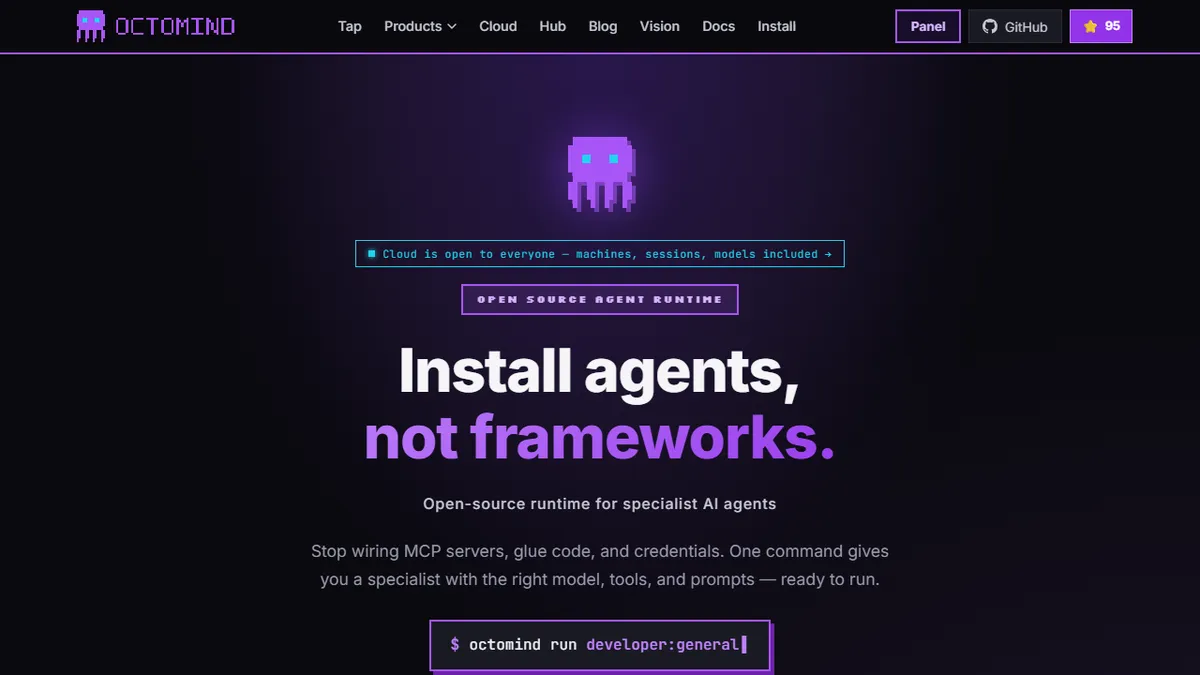
Octomind
Homebrew for AI agents: install specialized, budget-capped AI specialists with one command.
In short
Octomind functions as a package manager for AI agents, allowing users to install pre-configured domain specialists with a single command. It is best for engineering teams seeking reproducible, budget-capped agent workflows without building custom frameworks.
Engineering teams that want reproducible, budget-capped, provider-portable agent installs without stitching together an agent framework, eval harness, and spend guardrails themselves.
Non-technical users who want a click-to-configure chat UI, or teams that need a mature managed platform with published SLAs and enterprise procurement collateral.
Octomind is an open-source runtime for installing and orchestrating specialized AI agents, positioning itself as 'Homebrew for AI agents.' Instead of assembling an agent from raw prompts, tools, and model calls, users run a single command like `octomind run [specialist:domain]` to pull down a pre-configured specialist that already ships with the right model, system prompt, tool permissions, and evaluation harness for its domain. The catalog covers 116 specialists across 28 domains, including lawyers, doctors, engineers, security researchers, and other knowledge-worker archetypes. The runtime is distributed as a single binary via Homebrew, Cargo, or direct download, and speaks to 20+ model providers (OpenAI, Anthropic, DeepSeek, Ollama, and others) so teams can mix hosted and local inference. Two features stand out for long-running work: adaptive context compression, which the project claims reduces token spend by roughly 72.5 percent while keeping quality stable across 4+ hour sessions, and hard spending caps enforced per-request and per-session so runaway loops cannot burn a budget. Workflows chain specialists into automated pipelines, which lets teams compose narrow experts (e.g. threat-modeler then code-fixer then PR-writer) instead of asking one generalist to do it all. Octomind Cloud is the hosted companion for teams that would rather not run the binary themselves. It suits engineering-oriented teams who want reproducible agent installs, provider portability, and cost control without gluing together LangChain, an eval harness, and a budget guard by hand.
I like that Octomind treats agents like packages you install rather than snowflakes you build, and the hard spend caps plus provider portability are exactly the guardrails most homegrown agent stacks are missing. The 'Homebrew for AI agents' framing is apt: unglamorous plumbing done well. I'd want to spot-check the specialist quality and see published Cloud pricing before betting a team workflow on it.
— The AI Tool Bible editorial team
Pros
- ✅ One-command install of 116 pre-configured domain specialists across 28 fields
- ✅ Provider-agnostic with 20+ providers including Anthropic, OpenAI, DeepSeek, and local Ollama
- ✅ Hard per-request and per-session spending caps to prevent runaway agent costs
- ✅ Adaptive context compression cuts token spend ~72.5% over multi-hour sessions
- ✅ Apache 2.0 open source with a single-binary distribution (Homebrew, Cargo, direct)
- ✅ Workflows chain specialists into repeatable pipelines rather than one-shot chats
- ✅ Optional free Octomind Cloud tier for teams that don't want to self-host
Cons
- ⚠️ Command-line-first UX assumes comfort with a terminal and package managers
- ⚠️ Published pricing for Cloud paid tiers is not shown on the landing page
- ⚠️ Benchmark claims (24/25 PR tasks, 72.5% token reduction) are self-reported and hard to independently verify
- ⚠️ Specialist quality will vary across 116 preset agents, and vetting each is on the user
- ⚠️ Ecosystem is young compared to entrenched agent frameworks like LangGraph or CrewAI
Use cases
Frequently asked
- How does Octomind simplify AI agent deployment?
- It allows users to install pre-configured specialists using a single command like `octomind run [specialist:domain]`. Each specialist ships with the necessary model, system prompt, tool permissions, and evaluation harness.
- What mechanisms does Octomind use to control costs?
- The runtime enforces hard spending caps per-request and per-session to prevent runaway loops. It also features adaptive context compression, which claims to reduce token spend by roughly 72.5 percent during long sessions.
- Which AI model providers are supported by Octomind?
- Octomind supports over 20 model providers, including OpenAI, Anthropic, DeepSeek, and Ollama. This allows teams to mix hosted and local inference within their workflows.
- Is Octomind suitable for non-technical users?
- No, it is not recommended for non-technical users who prefer a click-to-configure chat UI. The tool is command-line-first and assumes comfort with terminals and package managers.
- What is the licensing model for Octomind?
- Octomind is open source under the Apache 2.0 license. It is distributed as a single binary via Homebrew, Cargo, or direct download, with a freemium pricing structure for its cloud companion.
Explore related
Compare with similar tools
All in Agents →LangGraph
FeaturedStateful, graph-based agent orchestration from LangChain.
CrewAI
FeaturedPython framework for multi-agent orchestration.
Ernie Bot
Baidu's Mandarin-first ChatGPT rival, powered by the ERNIE model family
Moveworks
The enterprise AI assistant that searches, answers, and takes action across your business systems
AWS Bedrock
Build and scale generative AI applications with foundation models
Claude Agent SDK
Anthropic's official SDK for building autonomous Claude agents.