Onyx
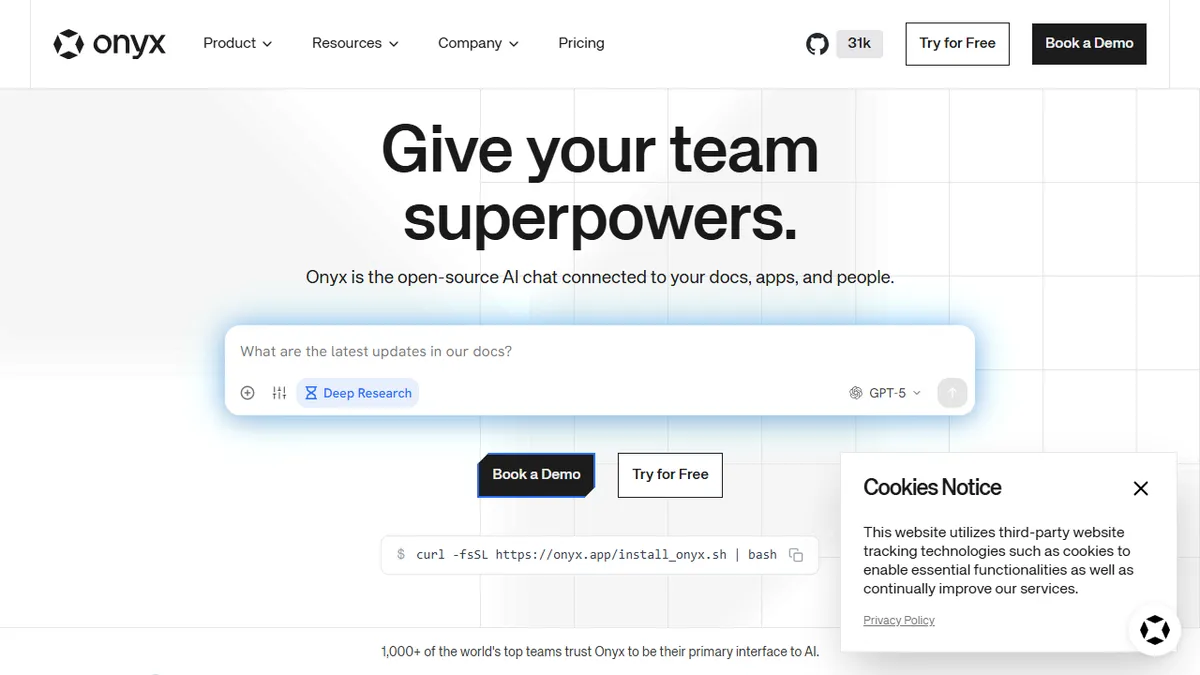
Open-source AI chat connected to your docs, apps, and people
In short
Onyx is an open-source RAG platform that ingests data from 40+ connectors to provide grounded, cited answers in a ChatGPT-style UI. It is best for enterprise teams needing permission-aware search across internal docs, code, and SaaS apps with LLM-agnostic flexibility.
Mid-size and enterprise teams that want a permission-aware, LLM-agnostic RAG chatbot over Google Drive, Slack, Confluence, Jira, and code repos — either self-hosted for data sovereignty or as a managed cloud with SSO.
Solo users or small teams who just want a personal ChatGPT wrapper, and shops that need a lightweight no-ops SaaS assistant without running Docker, Postgres, and a vector store.
Onyx (formerly known as Danswer) is an open-source enterprise search and AI chat platform that plugs a unified assistant into a company's internal knowledge base. It ingests content from 40+ connectors — Google Drive, Confluence, Notion, Slack, GitHub, Jira, Salesforce, Zendesk, SharePoint, S3, web pages, and more — and exposes it through a ChatGPT-style UI that grounds answers in retrieved documents with citations back to the source. Under the hood it runs a hybrid retrieval stack (BM25 plus dense embeddings) with a re-ranker, and supports pluggable LLM providers so teams can route to OpenAI, Anthropic, Azure, Bedrock, Vertex, Ollama, or self-hosted open-weight models. Beyond straight Q&A, Onyx ships a custom-agent framework, a code interpreter, image generation, web search, deep-research mode, and a Slack bot that answers threads in-channel. Access control is a first-class feature: connectors respect the source system's permissions so a user only ever sees retrieved snippets they were already authorized to read, which is what makes it viable inside larger organizations. Teams typically deploy it as an internal help-desk brain for support and sales, a code and design docs lookup for engineering, or a company-wide research assistant that replaces scattered knowledge searches. It is available as self-hosted Docker/Kubernetes for full data-plane control, a managed cloud with SOC 2 Type II and GDPR compliance, or an enterprise install with SSO, on-prem, and region-locked deployment.
Onyx is the strongest open-source pick if you need enterprise search that respects source-system permissions, and the LLM-agnostic backend means you are not locked into one provider. Self-hosting is real work — plan for a small ops footprint — but the payoff is a RAG stack you can actually audit, versus a black-box SaaS.
— The AI Tool Bible editorial team
Pros
- ✅ Open-source (MIT-adjacent) with active development and 20k+ GitHub stars, so you can self-host and audit the retrieval pipeline
- ✅ 40+ pre-built connectors for common SaaS and file stores, saving weeks of custom ETL work
- ✅ Permission-aware retrieval that honors source-system ACLs, avoiding the classic RAG leak of exposing restricted docs
- ✅ LLM-agnostic: swap between GPT, Claude, Gemini, Bedrock, or a local Ollama/vLLM model without rewriting the stack
- ✅ Hybrid search plus re-ranking out of the box, rather than a naive top-k vector lookup
- ✅ Custom agent framework, code interpreter, and Slack bot ship in-product, not as separate SKUs
- ✅ Cloud tier gives a managed option with SOC 2 Type II, GDPR, SSO, and audit logs for enterprise buyers
Cons
- ⚠️ Self-hosting is Docker/K8s-heavy and needs Postgres, Vespa/Vector store, and worker processes — not a one-click install for small teams
- ⚠️ Answer quality still depends heavily on your connector hygiene; stale or duplicated source docs produce confidently wrong answers
- ⚠️ Cloud pricing at $20/user/mo scales quickly for large orgs versus running the OSS build yourself
- ⚠️ Custom agent authoring is less mature than dedicated agent-builder tools like LangGraph or CrewAI
- ⚠️ Fine-grained observability (per-query latency, retrieval traces) is thinner than specialist LLMOps platforms
Use cases
Frequently asked
- What data sources does Onyx support?
- Onyx ingests content from over 40 connectors, including Google Drive, Confluence, Notion, Slack, GitHub, Jira, Salesforce, Zendesk, SharePoint, S3, and web pages.
- How does Onyx handle user permissions?
- Access control is a first-class feature where connectors respect the source system's permissions, ensuring users only see retrieved snippets they were already authorized to read.
- Which LLM providers can be used with Onyx?
- The platform supports pluggable LLM providers, allowing teams to route to OpenAI, Anthropic, Azure, Bedrock, Vertex, Ollama, or self-hosted open-weight models.
- What are the deployment options for Onyx?
- Onyx is available as self-hosted Docker/Kubernetes for full data-plane control, a managed cloud with SOC 2 Type II and GDPR compliance, or an enterprise install with SSO and on-prem capabilities.
- What is the pricing model for Onyx?
- Onyx operates on a freemium model, with a Business tier priced at $20 per user and an Enterprise tier available upon contact.
Explore related
Compare with similar tools
All in RAG →Pinecone
FeaturedManaged vector database for production-scale similarity search.
LlamaIndex
FeaturedData framework for connecting LLMs to your data.
Elasticsearch Vector Search
Hybrid vector + keyword search in the enterprise-grade Elasticsearch engine
Snowflake Cortex
Generative AI and RAG built into the Snowflake data cloud
DataStax Astra DB
Serverless vector and document database for production RAG and AI agents
MongoDB Atlas Vector Search
Vector search built into the operational database you're already using.