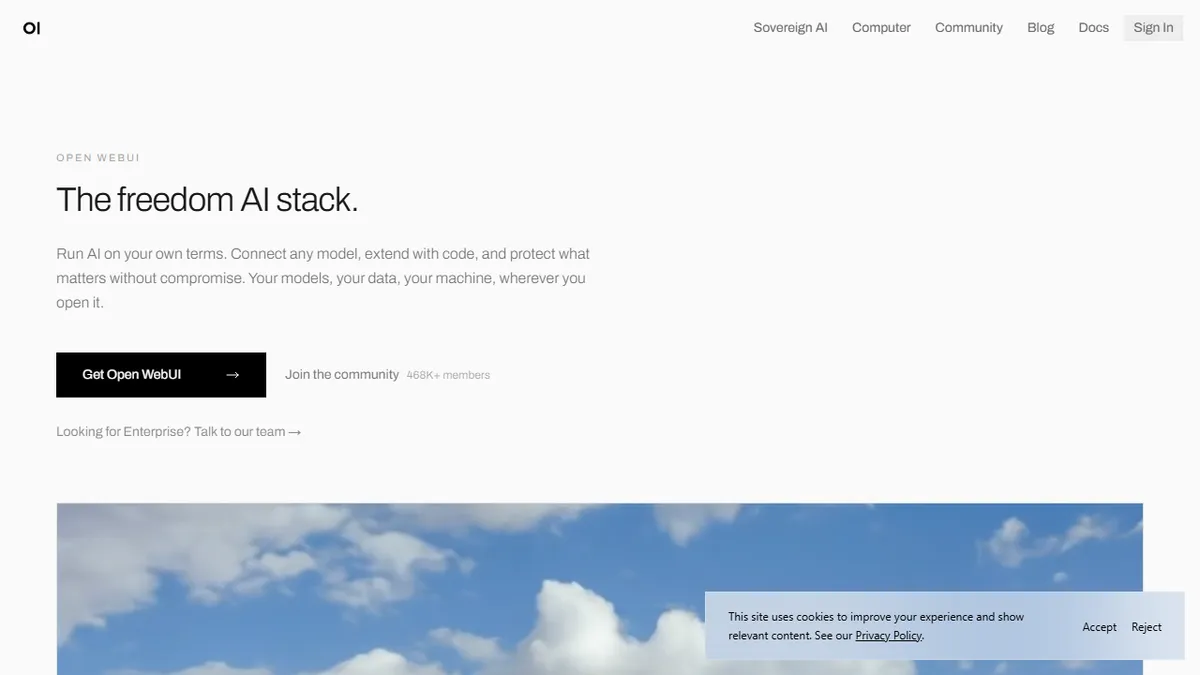
Open WebUI
Self-hosted, extensible AI chat platform that runs on your infrastructure
In short
Open WebUI is a self-hosted, open-source chat interface that connects to any OpenAI-compatible endpoint. It is best for developers and privacy-focused teams who want a ChatGPT-style UI with multi-user support, RAG, and custom Python pipelines without relying on a hosted vendor.
Developers, home-lab tinkerers, and privacy- or compliance-driven teams who want a polished, ChatGPT-style multi-user front end pointed at their own local or hosted LLMs.
Non-technical individuals who just want a hosted chatbot, or teams that need a fully managed SaaS with SLAs and zero infrastructure work.
Open WebUI is a self-hosted, open-source chat interface and orchestration layer for large language models. It began as a front end for Ollama and has grown into a full platform that connects to any OpenAI-compatible endpoint (Ollama, llama.cpp, vLLM, LM Studio, OpenAI, Anthropic, Groq, OpenRouter, and more), then wraps that connection with the features people expect from a modern chat product: multi-user accounts, workspaces, model management, RAG over uploaded documents, web search, image generation, voice input/output, function calling, and a Python-based pipelines system for custom tools and filters. Teams typically deploy it via Docker or pip in a few minutes on a laptop, a home lab, or a VPS, point it at whichever model backends they want, and immediately get a ChatGPT-style UI that stays entirely under their control. It is one of the most popular ways to give a family, small team, or regulated organization a shared LLM interface without sending traffic to a hosted vendor. Common workflows include running a private assistant against local Llama or Qwen models on a GPU box, giving a company access to multiple hosted providers through one auditable gateway, building RAG chatbots over internal document collections, exposing custom Python functions as tools the model can call, and standing up an air-gapped chat environment for defense, healthcare, or legal use. The project has one of the largest communities in the open LLM tooling space (148K+ GitHub stars, hundreds of millions of Docker pulls) and ships new features almost weekly, including model evaluation, prompt libraries, memory, and a marketplace of community-contributed tools, functions, and models.
Open WebUI is the default answer when someone asks how to give a team a shared, private ChatGPT-like experience on top of Ollama or any OpenAI-compatible endpoint. It is remarkably feature-complete for a self-hosted project, and the pipelines system means you can grow into agent-style workflows without leaving the app. Expect to do real ops work, though; this is a platform you run, not a service you buy.
— The AI Tool Bible editorial team
Pros
- ✅ Genuinely self-hostable in minutes with Docker or pip; no account or callback required
- ✅ Backend-agnostic: talks to Ollama, llama.cpp, vLLM, OpenAI, Anthropic, Groq, OpenRouter and any OpenAI-compatible API through one UI
- ✅ Built-in RAG over uploaded docs, web search, image generation, voice, and function calling
- ✅ Python pipelines and tools framework lets you extend the app without forking it
- ✅ Multi-user with roles, workspaces, model access controls, and audit-friendly logs
- ✅ Very active community with a marketplace of shared prompts, models, tools, and functions
- ✅ Enterprise tier adds SSO, RBAC, and air-gapped deployment for regulated environments
Cons
- ⚠️ You are responsible for hosting, updates, GPU/model provisioning, and backups
- ⚠️ Feature velocity is high, so breaking changes and rough edges appear between releases
- ⚠️ RAG and evaluation features are competent but not as deep as purpose-built tools like LangChain, LlamaIndex, or Ragas
- ⚠️ Enterprise pricing is not published and requires a sales conversation
- ⚠️ Multi-tenant performance depends entirely on the model backend you wire in; the UI cannot fix a slow local model
Use cases
Frequently asked
- Which model backends does Open WebUI support?
- It connects to any OpenAI-compatible endpoint, including Ollama, llama.cpp, vLLM, LM Studio, OpenAI, Anthropic, Groq, and OpenRouter. This allows users to switch between local and hosted models through a single interface.
- How is Open WebUI deployed and what are the costs?
- The platform is free to self-host via Docker or pip under an MIT-style community license. An enterprise tier with custom pricing is available for features like SSO, RBAC, and air-gapped deployment.
- What features are included in the free self-hosted version?
- The free version includes multi-user accounts, workspaces, model management, RAG over uploaded documents, web search, image generation, voice input/output, and a Python-based pipelines system for custom tools.
- Who is Open WebUI not suitable for?
- It is not intended for non-technical individuals seeking a hosted chatbot or teams requiring a fully managed SaaS with SLAs and zero infrastructure work, as users must handle hosting, updates, and backups.
Explore related
Compare with similar tools
All in Agents →LangGraph
FeaturedStateful, graph-based agent orchestration from LangChain.
CrewAI
FeaturedPython framework for multi-agent orchestration.
Ernie Bot
Baidu's Mandarin-first ChatGPT rival, powered by the ERNIE model family
Moveworks
The enterprise AI assistant that searches, answers, and takes action across your business systems
AWS Bedrock
Build and scale generative AI applications with foundation models
Claude Agent SDK
Anthropic's official SDK for building autonomous Claude agents.