Quivr
✓ Editorially verifiedOpen-source RAG framework for building custom AI assistants over your own documents in a few lines of Python.
In short
Quivr is a lightweight, open-source Python library that provides a complete RAG pipeline for building document-based AI assistants. It is best for developers who want model-agnostic flexibility and minimal boilerplate without a hosted SaaS interface.
Pick Quivr if you are a Python developer who wants a lightweight, model-agnostic RAG library you can extend rather than a hosted chat-your-docs SaaS.
Skip it if you want a turnkey no-code product with a polished UI, hosted vector store, and a sales team to call.
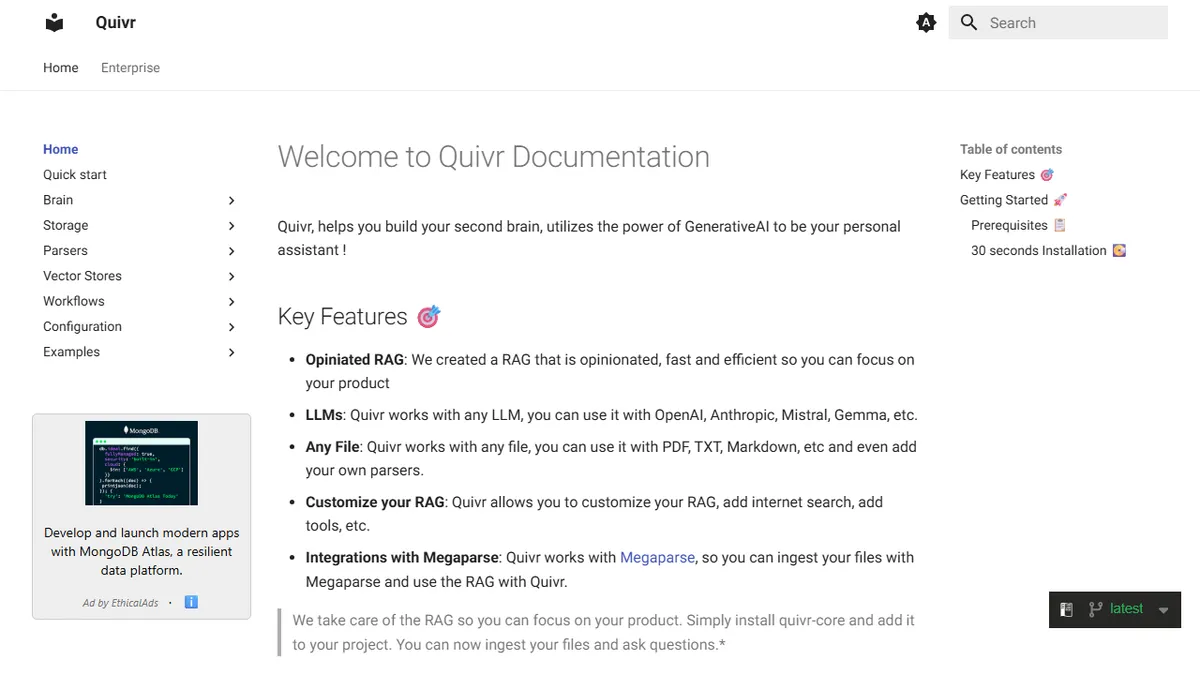
Quivr (specifically quivr-core) is the open-source Python library at the heart of the Quivr project, giving developers a batteries-included RAG pipeline they can drop into their own applications. It handles the usual chores of building a chat-over-your-docs system: ingesting PDFs, text, and Markdown files, chunking and embedding them, retrieving the right context, and routing the question to a chosen LLM. The pitch is that you can wire up a working assistant in roughly five lines of code, then progressively customize the pipeline with tools and internet search as your use case grows.
It is model-agnostic, with first-class support for OpenAI, Anthropic, Mistral, and Gemma, so teams can mix providers or swap them out without rebuilding the stack. It pairs naturally with Megaparse, the same team's document-parsing library, which matters if you are dealing with messy real-world PDFs. Pricing isn't a factor since the core library is free and installed via pip; you only pay for the LLM and any vector store you bring. This is squarely a developer tool, not a no-code SaaS, so expect to write Python and host the runtime yourself.
The trade-off versus hosted RAG platforms is the usual one: more flexibility and no per-seat fee, but you own the infra, observability, and evals. Teams that previously used the Quivr hosted product will recognize the philosophy, but core is the library layer rather than a full UI.
Quivr-core is a sensible pick for teams who have outgrown LangChain demos but don't want to assemble a RAG stack from scratch. It's not trying to be everything, which is the point - lean library, swap your own models, ship. Worth a look alongside LlamaIndex and Haystack.
— The AI Tool Bible editorial team
Pros
- ✅ Genuinely open source and pip-installable, no vendor lock-in
- ✅ Model-agnostic: OpenAI, Anthropic, Mistral, and Gemma supported
- ✅ Minimal boilerplate to get a working RAG assistant running
- ✅ Pairs with Megaparse for tougher PDF and document ingestion
- ✅ Customizable pipeline with tools and web search when you need more
Cons
- ⚠️ Python library, not a hosted product or UI
- ⚠️ You manage infra, vector store, and evals yourself
- ⚠️ Documentation site is sparse compared to larger RAG frameworks
- ⚠️ LLM and embedding costs are on you
Use cases
Frequently asked
- What programming language is required to use Quivr?
- Quivr is a Python library that you install via pip. It is designed for developers who are comfortable writing Python code and managing their own runtime infrastructure.
- Which large language models does Quivr support?
- Quivr is model-agnostic and offers first-class support for OpenAI, Anthropic, Mistral, and Gemma. This allows teams to mix providers or swap them out without rebuilding the stack.
- Is Quivr a hosted service or a self-hosted library?
- Quivr is an open-source library, not a hosted product or UI. You are responsible for managing the infrastructure, vector store, and observability yourself.
- How does Quivr handle document ingestion?
- It handles ingesting PDFs, text, and Markdown files, including chunking and embedding. It also pairs naturally with Megaparse, a document-parsing library from the same team, for handling messy real-world PDFs.
- What are the costs associated with using Quivr?
- The core library is free and open source. You only pay for the usage of the LLM and any vector store you choose to integrate with the system.
Explore related
Compare with similar tools
All in RAG →Pinecone
FeaturedManaged vector database for production-scale similarity search.
LlamaIndex
FeaturedData framework for connecting LLMs to your data.
Elasticsearch Vector Search
Hybrid vector + keyword search in the enterprise-grade Elasticsearch engine
Snowflake Cortex
Generative AI and RAG built into the Snowflake data cloud
DataStax Astra DB
Serverless vector and document database for production RAG and AI agents
MongoDB Atlas Vector Search
Vector search built into the operational database you're already using.