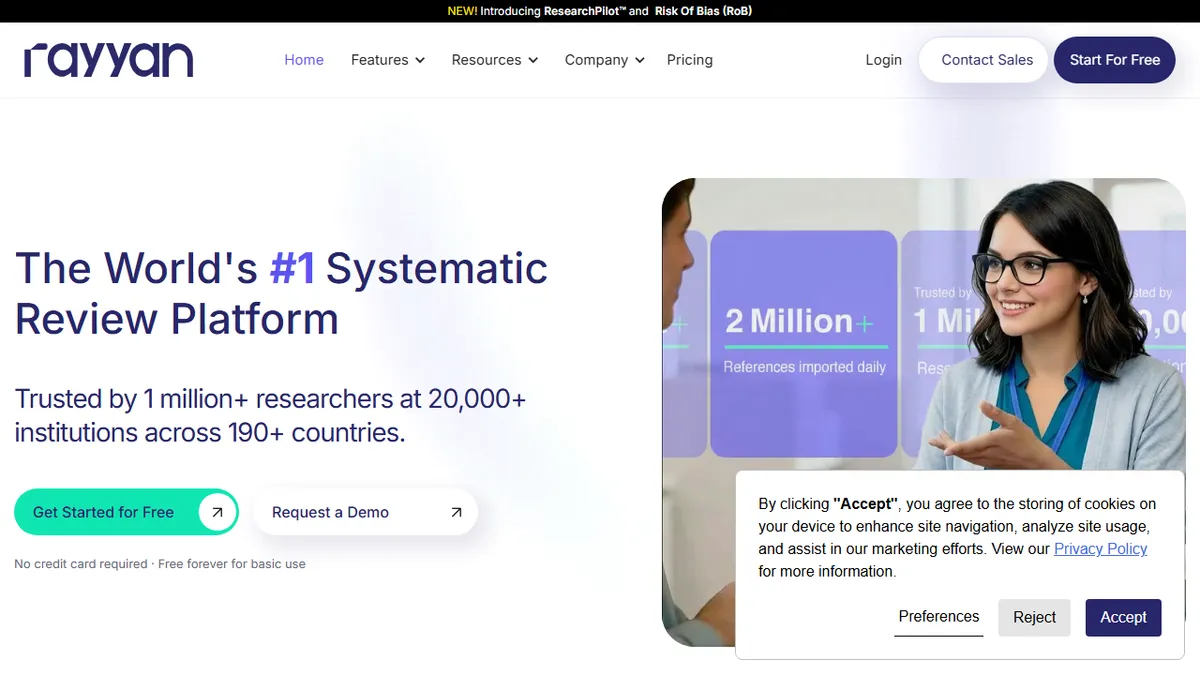

Rayyan
AI-assisted systematic review platform for screening, deduplicating, and extracting data from large literature corpora.
In short
Rayyan is a cloud platform purpose-built for systematic and literature reviews, handling the full pipeline from deduplication to PRISMA-compliant screening. It is best for researchers and teams needing AI-assisted prioritization and structured data extraction for evidence-based studies.
Pick Rayyan if you are running a formal systematic or scoping review and need PRISMA-compliant screening with team workflows and AI-assisted prioritization.
Skip it if you want a general-purpose chat-with-your-PDFs RAG tool or a self-hosted, open-source alternative.
Rayyan is a cloud platform built specifically for systematic and literature reviews, the kind of multi-thousand-paper screening exercises that dominate evidence-based medicine, health policy, and meta-analytic research. It handles the full pipeline: importing references, deduplicating up to 200,000 records, title/abstract screening with AI prioritization, full-text eligibility checks, structured data extraction, risk-of-bias assessment, and auto-generated PRISMA flow diagrams. A mobile app supports offline screening, and team workflows include role assignment and workload sampling for blinded multi-reviewer projects.
The differentiator is domain specificity. Rayyan isn't a generic RAG tool repurposed for academia, it was purpose-built with the Cochrane/Campbell systematic-review crowd in mind and now claims over a million researchers across 20,000+ institutions. The newer ResearchPilot tier adds zero-shot relevance ratings, an AI Analyzer, an AI Reviewer, and Auto-Extract Data, pushing into territory that historically required a graduate student-month of manual labor. Pricing is freemium: a permanent free tier for individual basic use, with enterprise plans for institutions and pharma/biotech sponsors negotiated via sales.
An API exists for programmatic integration, useful for institutional librarians wiring Rayyan into wider research-ops stacks. The product is proprietary SaaS, not open source, and its AI assist is screening-oriented rather than a general-purpose retrieval interface, so teams looking for a build-your-own RAG over papers will find this opinionated.
Rayyan is the default for serious systematic reviewers for a reason: deep domain fit, large-scale dedup, and an AI assist that actually targets the bottleneck (title/abstract screening). The ResearchPilot additions push it toward genuine automation, though institutions should price the enterprise tier before committing.
— The AI Tool Bible editorial team
Pros
- ✅ Purpose-built for systematic reviews, not retrofitted from a generic tool
- ✅ Handles up to 200,000 references with robust deduplication
- ✅ AI prioritization meaningfully cuts manual screening time
- ✅ Free tier is genuinely usable for solo researchers
- ✅ Mobile + offline support is rare in this category
Cons
- ⚠️ Proprietary SaaS with no self-hosted option
- ⚠️ Enterprise pricing opaque, requires sales contact
- ⚠️ AI features are workflow-bound, not a general RAG interface
Use cases
Frequently asked
- What is Rayyan best used for?
- Rayyan is best for running formal systematic or scoping reviews. It supports multi-thousand-paper screening exercises, deduplication of up to 200,000 records, and structured data extraction for meta-analytic research.
- Does Rayyan offer a free plan?
- Yes, Rayyan offers a freemium model with a permanent free tier for basic individual use. Enterprise custom pricing is available for institutions and sponsors, negotiated via sales.
- Can I use Rayyan offline or on mobile?
- Yes, Rayyan provides a mobile app that supports offline screening. This allows reviewers to continue work without an internet connection, which is noted as rare in this category.
- Is Rayyan an open-source tool?
- No, Rayyan is proprietary SaaS and is not open source. It does not offer a self-hosted option, though it does provide an API for programmatic integration.
Explore related
Compare with similar tools
All in RAG →Pinecone
FeaturedManaged vector database for production-scale similarity search.
LlamaIndex
FeaturedData framework for connecting LLMs to your data.
Elasticsearch Vector Search
Hybrid vector + keyword search in the enterprise-grade Elasticsearch engine
Snowflake Cortex
Generative AI and RAG built into the Snowflake data cloud
DataStax Astra DB
Serverless vector and document database for production RAG and AI agents
MongoDB Atlas Vector Search
Vector search built into the operational database you're already using.