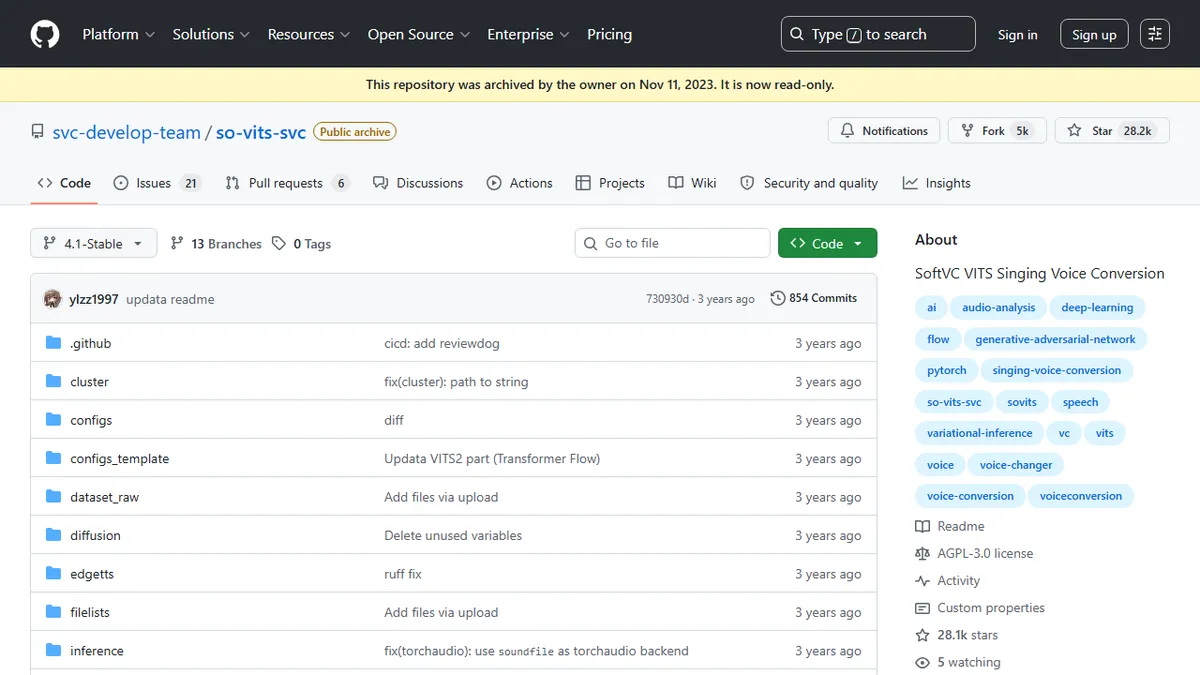
so-vits-svc
SoftVC VITS Singing Voice Conversion — open-source pipeline for training and running singing-voice models.
In short
so-vits-svc transforms existing vocal recordings to match a different singer's timbre while preserving pitch and phrasing. It is best for users who want a locally trained, fully controllable model and are comfortable with Python and CUDA setup.
Producers, researchers and VTuber/virtual-character teams who want a locally trained, fully controllable singing-voice model and are comfortable with Python, CUDA and dataset prep.
Anyone who wants a hosted, click-to-clone service, needs a supported product with SLAs, or intends to imitate a real singer without their consent.
so-vits-svc (SoftVC VITS Singing Voice Conversion) is an open-source, offline toolkit for training and running singing-voice conversion models. Rather than synthesising speech from text, it transforms an existing vocal recording so it takes on a different singer's timbre while preserving the source pitch, phrasing and intonation. Under the hood it feeds SoftVC-encoded content features directly into a VITS backbone and swaps the standard vocoder for NSF-HiFiGAN, which cleans up the characteristic 'electronic' artifacts of earlier SVC systems. The 4.1-stable branch adds shallow-diffusion post-processing, multiple pluggable content encoders (ContentVec, HuBERT-Soft, Whisper-PPG, WavLM), static and dynamic speaker mixing, a feature-retrieval / clustering module for stronger timbre control, and ONNX export for downstream deployment. The project is aimed at researchers, vocal-synthesis hobbyists, indie producers and VTuber / virtual-character creators who want full control over a locally-trained voice model — dataset curation, preprocessing (f0 extraction, resampling, chunking), training loop, checkpoint management and inference all live on your own machine. There is no hosted service and no one-click UI in the repo itself; the community typically pairs it with third-party WebUI wrappers. Note: the upstream repo was archived on 2023-11-11, so it is feature-frozen — bug fixes and new encoders now come from forks. The maintainers explicitly frame the project as intended for fictional / consented voices only and disclaim liability for misuse.
Still the reference implementation for open-source singing voice conversion — the NSF-HiFiGAN + shallow-diffusion combo genuinely sounds better than most hosted 'AI cover' toys. But it is a research codebase, now archived: budget for a weekend of setup, a decent GPU, and be honest with yourself about whose voice you are training on.
— The AI Tool Bible editorial team
Pros
- ✅ Fully open source (AGPL-3.0) and runs entirely offline — no per-use fees, no data leaving your machine.
- ✅ State-of-the-art singing quality for its generation: NSF-HiFiGAN vocoder + shallow diffusion noticeably reduce breath and sibilance artifacts.
- ✅ Pluggable content encoders (ContentVec, HuBERT-Soft, Whisper-PPG, WavLM) let you trade off timbre leakage vs. pronunciation fidelity.
- ✅ Speaker mixing (static and dynamic) and clustering-based timbre control give producers real creative knobs beyond one-shot conversion.
- ✅ ONNX export enables inference on non-PyTorch runtimes and lighter deployment targets.
- ✅ Huge community: 28k+ GitHub stars, dozens of active forks, tutorials, and ready-made WebUI front-ends.
Cons
- ⚠️ Upstream repo is archived (Nov 2023) — no official updates, security fixes or new-model support; you rely on forks.
- ⚠️ Steep setup: CUDA GPU, correct PyTorch/torchaudio versions, manual f0 extraction and slicing, and hours-to-days of training per voice.
- ⚠️ No built-in UI or hosted inference — you either script it or bolt on a third-party WebUI.
- ⚠️ Documentation is uneven and partly Chinese-first; several config knobs (diffusion depth, cluster ratio, encoder choice) require trial and error.
- ⚠️ Serious ethical / legal exposure: cloning a real person's singing voice without consent runs into copyright, publicity-rights and (increasingly) deepfake-specific laws — the license does not absolve you.
Use cases
Frequently asked
- Is so-vits-svc a hosted service?
- No, it is an offline toolkit that runs entirely on your own machine. You must provide your own compute resources, typically a CUDA-capable GPU, and there is no hosted inference service.
- What are the system requirements for running so-vits-svc?
- You need a CUDA-capable GPU, correct PyTorch and torchaudio versions, and must handle manual preprocessing steps like f0 extraction and slicing. Training can take hours to days per voice.
- Is the so-vits-svc project still actively maintained?
- The upstream repository was archived in November 2023, making it feature-frozen. Bug fixes and new features are now provided by community forks rather than the original maintainers.
- Does so-vits-svc include a user interface?
- The repository itself does not include a one-click UI or built-in interface. Users typically script the process or pair it with third-party WebUI wrappers to interact with the model.
- What ethical guidelines does the project recommend?
- The maintainers frame the project as intended for fictional or consented voices only. They explicitly disclaim liability for misuse, such as imitating a real singer without their consent.
Explore related
Compare with similar tools
All in Audio →ElevenLabs
FeaturedThe gold standard for AI voice cloning and TTS.
Suno
FeaturedText-to-song AI — full vocal tracks from a prompt.
Udio
Suno's main rival for AI-generated full songs.
AssemblyAI
Speech-to-text API with diarisation, summarisation, and topic detection.
Chorus by ZoomInfo
Enterprise conversation intelligence bundled with ZoomInfo's B2B data graph
Whisper
OpenAI's open-source speech-to-text — the de-facto baseline.