Supabase
Open-source Firebase alternative built on Postgres with a first-class pgvector AI toolkit.
In short
Supabase is an open-source Firebase alternative built on Postgres that integrates pgvector for AI applications. It is best for full-stack developers who want to store embeddings alongside transactional data in a single database schema.
Full-stack and AI developers building RAG apps, semantic search, or agent memory who want embeddings, auth, storage, and business data in one Postgres database.
Teams that need a specialist billion-scale vector database, or non-technical users who want a no-code chatbot builder without writing SQL or backend code.
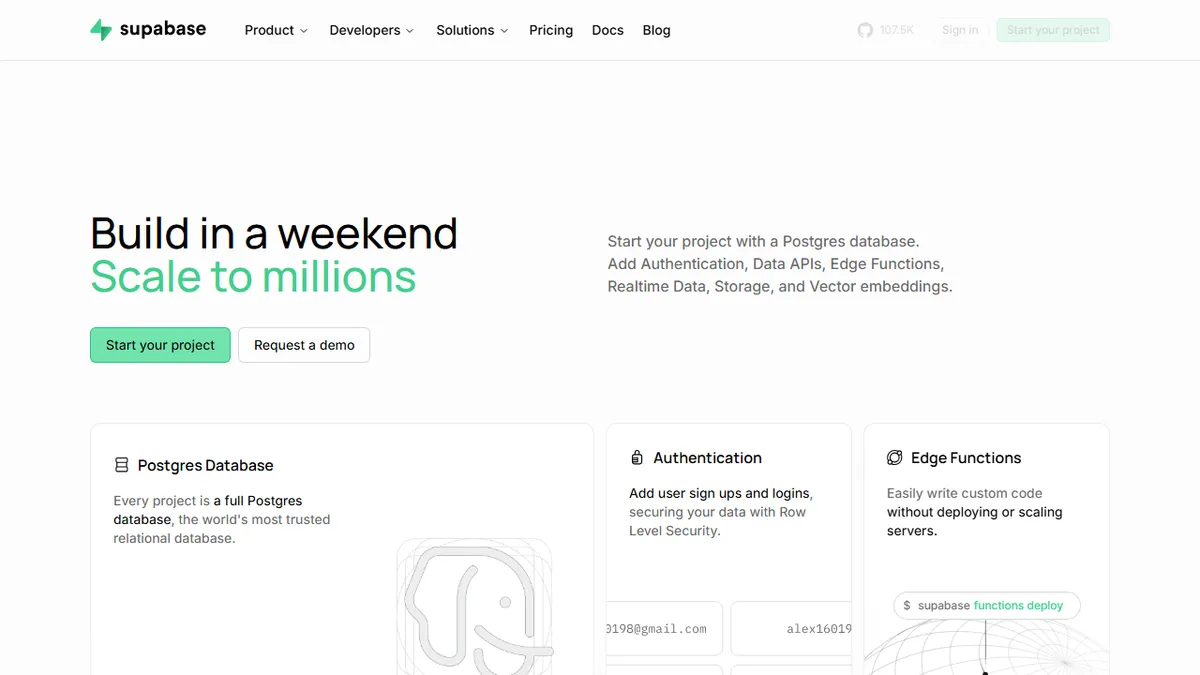
Supabase is an open-source backend-as-a-service built on Postgres that has become one of the most popular vector stores for AI applications. It packages a dedicated Postgres database, auto-generated REST and GraphQL APIs (via PostgREST and pg_graphql), row-level-security auth with 20+ social providers, S3-compatible object storage with a 285+ city CDN, realtime subscriptions, and serverless Edge Functions behind a single dashboard and CLI. For AI teams the headline feature is the deep pgvector integration: you can store embeddings alongside your transactional data, index them with IVFFlat or HNSW, and query them with SQL joins instead of maintaining a separate vector database. The platform ships an AI toolkit with LangChain, LlamaIndex, and OpenAI examples, plus a hosted vector-enabled storage bucket type. Typical workflows include RAG chatbots that keep documents, chunks, embeddings, and chat history in one schema; semantic search over product catalogs; hybrid keyword-plus-vector retrieval; and agent memory backed by Postgres. Developers get a generous free tier (2 projects, 500 MB, unlimited API requests), a straightforward $25/month Pro plan, a self-hostable Docker stack for teams that need to keep data on their own infrastructure, and enterprise options with SOC2/ISO 27001 compliance and BYO-Cloud deployments. It suits full-stack developers who want a Postgres-first alternative to Firebase without adopting a proprietary vector service, and teams migrating off single-purpose vector DBs who want to consolidate on SQL.
Supabase is our default recommendation when a project needs both a real backend and a vector store. Keeping embeddings inside Postgres eliminates a whole class of sync bugs, and the open-source stack means you are never locked in. It is not the fastest vector DB at extreme scale, but for the 95% of RAG apps under a few million chunks, one Postgres is the right answer.
— The AI Tool Bible editorial team
Pros
- ✅ pgvector is deeply integrated so embeddings live in the same Postgres schema as your business data, enabling SQL joins between rows and vectors.
- ✅ Fully open source and self-hostable via Docker, so you can move off the hosted platform without rewriting your app.
- ✅ Auto-generated REST and GraphQL APIs plus row-level security remove huge amounts of backend boilerplate for AI app prototypes.
- ✅ Realtime subscriptions and Edge Functions let you stream RAG results and run inference glue code close to the database.
- ✅ Generous free tier with unlimited API requests and 2 projects makes it easy to prototype AI features without a credit card.
- ✅ First-party guides and starters for LangChain, LlamaIndex, OpenAI, and Hugging Face reduce the time to a working RAG stack.
Cons
- ⚠️ It is a Postgres backend platform, not an AI product per se, so you still need to bring your own embedding model, LLM, and orchestration layer.
- ⚠️ pgvector at very high dimensionality or billion-scale corpora can lag purpose-built vector databases like Pinecone or Milvus on latency and index build time.
- ⚠️ Free-tier projects pause after a week of inactivity, which surprises hobbyists running demo RAG bots.
- ⚠️ The jump from $25 Pro to $599 Team is steep for small teams that need SOC2 or SLAs.
- ⚠️ Self-hosting the full stack (Studio, GoTrue, Storage, Realtime, Kong, PostgREST) is doable but operationally heavier than a managed vector service.
Use cases
Frequently asked
- How does Supabase handle vector data for AI applications?
- It uses deep pgvector integration to store embeddings alongside transactional data in Postgres. This allows developers to index vectors with IVFFlat or HNSW and query them using SQL joins.
- What is the pricing structure for Supabase?
- Supabase offers a freemium model with a free tier, a Pro plan at $25, a Team plan at $599, and custom Enterprise pricing. The free tier includes two projects and unlimited API requests.
- Can I self-host Supabase for my AI project?
- Yes, Supabase is fully open source and self-hostable via Docker. This allows teams to keep data on their own infrastructure without rewriting their application code.
- Does Supabase include tools for building RAG chatbots?
- Yes, the platform ships with an AI toolkit featuring examples for LangChain, LlamaIndex, and OpenAI. It supports workflows like RAG chatbots, semantic search, and agent memory backed by Postgres.
- Is Supabase suitable for billion-scale vector databases?
- It is not recommended for teams needing a specialist billion-scale vector database. At very high dimensionality or scale, it may lag behind purpose-built vector databases like Pinecone or Milvus.
Explore related
Compare with similar tools
All in RAG →Pinecone
FeaturedManaged vector database for production-scale similarity search.
LlamaIndex
FeaturedData framework for connecting LLMs to your data.
Elasticsearch Vector Search
Hybrid vector + keyword search in the enterprise-grade Elasticsearch engine
Snowflake Cortex
Generative AI and RAG built into the Snowflake data cloud
DataStax Astra DB
Serverless vector and document database for production RAG and AI agents
MongoDB Atlas Vector Search
Vector search built into the operational database you're already using.