
Vanna.ai
✓ Editorially verifiedOpen-source text-to-SQL agent that learns your schema and writes queries against your real warehouse.
In short
Vanna.ai converts natural language into executable SQL by leveraging a RAG layer over your database schema and documentation. It is best for data teams who want a self-hostable, model-agnostic solution that avoids sending data to closed SaaS platforms.
Pick Vanna.ai if you want a self-hostable, model-agnostic text-to-SQL layer you can train on your own warehouse without shipping schemas to a closed SaaS.
Skip it if you want a no-code BI dashboard out of the box or have no appetite to curate training examples for accuracy.
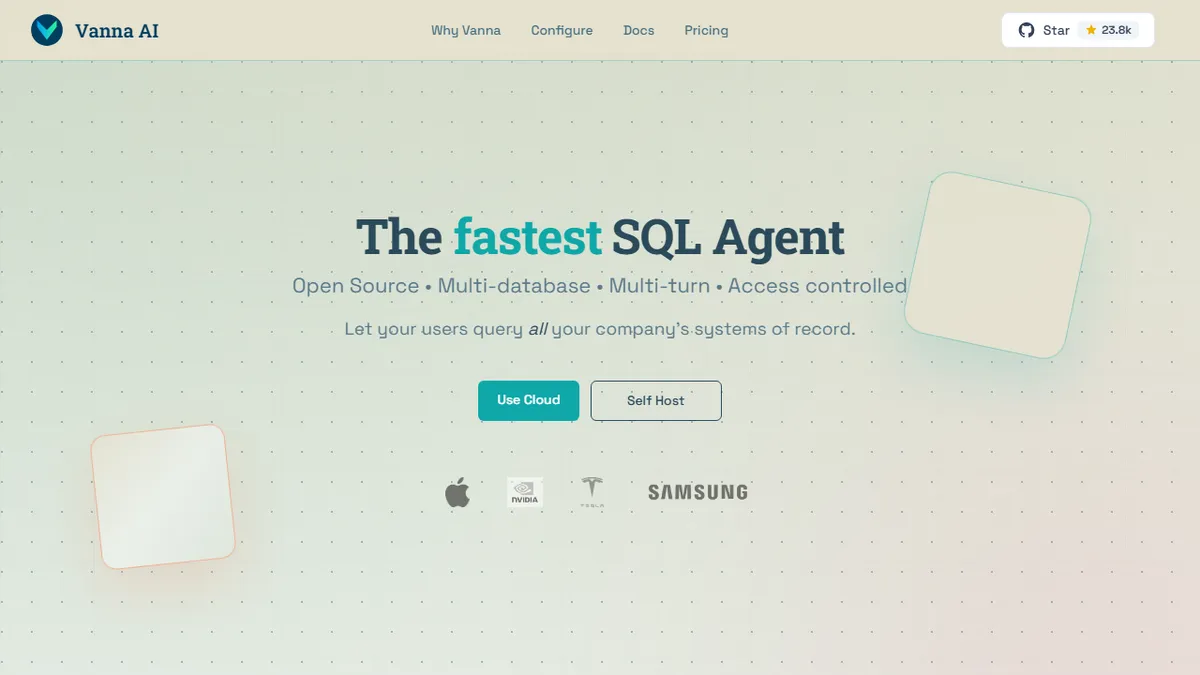
Vanna is a Python framework (and hosted cloud product) that turns natural-language questions into executable SQL against your own database. It connects to SQLite, Postgres, MySQL, Snowflake, BigQuery and other common engines, runs a RAG layer over your DDL, documentation, and example queries, then asks the LLM of your choice to produce a query, execute it, and return results plus a chart. The 2.0 release adds multi-turn conversations and an admin layer with access control, audit logs, and observability.
The differentiator is honesty about how text-to-SQL actually works: instead of pretending one zero-shot prompt is enough, Vanna leans on a trainable vector store of your schema and prior good queries, and it's model-agnostic across Anthropic, OpenAI, Gemini, and local Ollama. The core framework is MIT-licensed and self-hostable for free; the cloud tier is for teams that want a managed vector store, governance, and a hosted UI rather than wiring Streamlit/Flask themselves. It's aimed at data teams who want analyst-style self-serve without handing the warehouse to a black-box SaaS.
Because it's a library first, integrations are flexible: bring your own LLM, your own vector DB (Chroma, pgvector, Pinecone, etc.), and your own front-end. The trade-off is that quality scales with how much training data (DDL + curated Q/SQL pairs) you feed it, and it inherits whatever the underlying LLM gets wrong about joins on messy schemas.
Vanna is the most credible open-source take on text-to-SQL because it treats schema as a retrieval problem, not a prompting trick. The framework is genuinely useful even if you never touch the cloud tier, and being LLM-agnostic future-proofs it. Just budget time to feed it good examples; that's where the accuracy actually comes from.
— The AI Tool Bible editorial team
Pros
- ✅ MIT-licensed core; fully self-hostable with your own LLM and vector store
- ✅ Model-agnostic across Anthropic, OpenAI, Gemini, and local Ollama
- ✅ Trainable on your schema, docs, and prior queries via RAG (not zero-shot)
- ✅ Connects directly to Snowflake, BigQuery, Postgres, MySQL, SQLite and more
- ✅ Cloud tier adds access control, audit logs, and observability for teams
Cons
- ⚠️ Quality depends heavily on how much training data you curate
- ⚠️ Self-hosted setup requires Python and some glue work
- ⚠️ Inherits LLM hallucinations on complex joins or messy schemas
Use cases
Frequently asked
- Which database engines does Vanna.ai support?
- Vanna connects to common engines including SQLite, Postgres, MySQL, Snowflake, and BigQuery. It generates and executes SQL queries directly against these databases.
- Is Vanna.ai open source and self-hostable?
- Yes, the core framework is MIT-licensed and fully self-hostable. You can bring your own LLM and vector database, such as Chroma, pgvector, or Pinecone, without relying on a closed SaaS.
- How does Vanna.ai ensure query accuracy?
- It uses a RAG layer over your DDL, documentation, and example queries rather than relying solely on zero-shot prompting. Accuracy scales with the amount of curated training data you provide.
- What LLMs are compatible with Vanna.ai?
- The tool is model-agnostic and supports Anthropic, OpenAI, Gemini, and local Ollama models. This allows users to choose the LLM that best fits their privacy and performance needs.
- What features are included in the cloud tier?
- The cloud tier provides a managed vector store, governance, and a hosted UI. It also adds an admin layer with access control, audit logs, and observability for team environments.
Explore related
Compare with similar tools
All in RAG →Pinecone
FeaturedManaged vector database for production-scale similarity search.
LlamaIndex
FeaturedData framework for connecting LLMs to your data.
Elasticsearch Vector Search
Hybrid vector + keyword search in the enterprise-grade Elasticsearch engine
Snowflake Cortex
Generative AI and RAG built into the Snowflake data cloud
DataStax Astra DB
Serverless vector and document database for production RAG and AI agents
MongoDB Atlas Vector Search
Vector search built into the operational database you're already using.